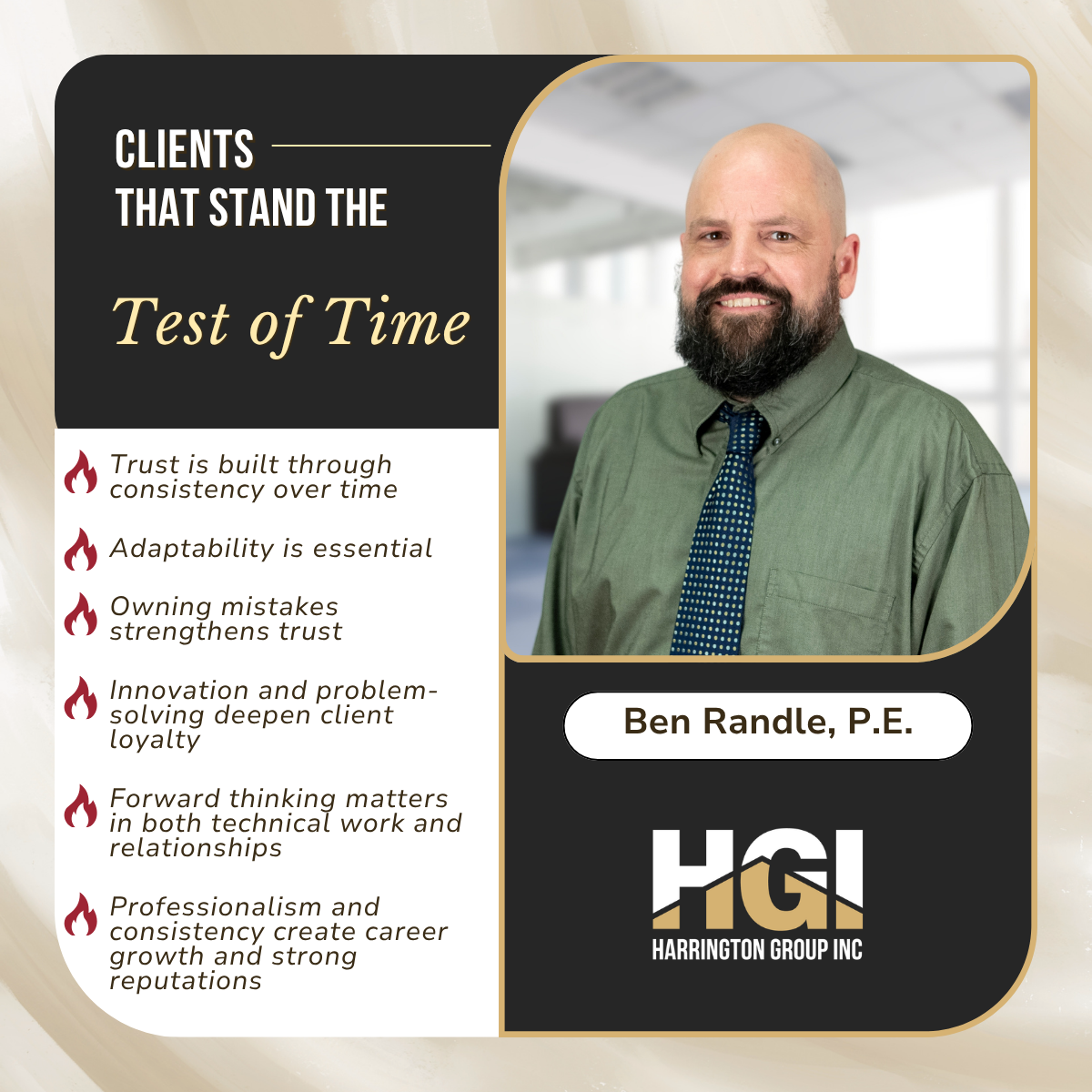
When you talk with someone who has spent decades building client partnerships in fire protection engineering consulting, patterns start to emerge. Not in the form of buzzwords or formulas, but through stories. Moments where trust was tested. Decisions that required flexibility. Projects that asked for something entirely new. For Ben Randle, long-term client relationships have never just been about a “secret sauce.” They’ve been about building a level of client intimacy where you show up consistently, adapt when things change, and remain willing to solve problems that don’t yet have clear answers.
Over the course of his career, Ben has worked closely with some of the largest and most well-known companies in the country. And while the scale of those organizations presents challenges of its own, the foundation of the relationship is surprisingly simple: understanding who you’re serving and making sure their needs are truly met. An approach rooted in client intimacy and a deep understanding of each client’s goals and challenges.
“There’s a certain expectation when you’re working with long-time clients,” Ben explained. “It’s making sure their needs are fulfilled, and then continuing that process over the years. When things change, you have to be able to adapt and support those changes.”
That adaptability, especially with large and complex organizations, is what keeps a partnership moving forward instead of stalling out. It’s also a key part of maintaining strong client intimacy over time and where trust really starts to grow. Ben often points to the moments when something goes wrong as the most important test of a relationship. “If you want to compare it to a marriage, it’s never going to be perfect,” he said. “But when things go wrong, we own up to those mistakes. We fix them and make sure we don’t repeat them. That’s how you build trust over time.”
One project in particular stands out when Ben talks about relationships that truly deepened. Years ago, a client approached HGI with a request that didn’t fit within traditional codes or standard solutions. They wanted to build something completely out of the ordinary, and they needed help making it possible. The team worked through the challenge, developing a solution that required research, fire testing, and coordination well beyond a typical fire protection engineering consulting project. The result was a building unlike anything else in their industry at the time.
Then, years later, that same client came back.
“Five to ten years later, they said, ‘We’re going to do this again,’” Ben recalled. “They set out to build another facility unlike anything that had been done before, and once again trusted us to help solve that challenge.”
The client’s concern wasn’t just cost. It was time. Without a performance-based approach and innovative testing, construction would drag on, delaying operations and ultimately the client’s planned revenue. By thinking beyond prescriptive codes, HGI helped shorten construction by up to a year. “They can’t make money while the building is still being built,” Ben said. “If you add a year to construction, that’s a massive amount of lost revenue.” These are the moments where technical expertise, creative thinking, and trust intersect and turn a project into a long-term partnership.
Over his 30-year career, Ben’s approach has evolved alongside the industry itself. Codes have grown more complex. Expectations have shifted. But the core mindset remains the same: stay curious, stay flexible, and think ahead. “My first NFPA code book was a pamphlet,” he said with a laugh. “Now it’s five times that size. You can’t just design to today’s adopted code. You have to look five or six years ahead and understand where the industry is going.” That forward-thinking mindset extends beyond technical work and into how Ben and HGI approach relationships with clients and with teammates.
When asked what advice he’d give to someone early in their career, his answer was refreshingly straightforward: “Show up to work and do your job well. That’s it.”
Be willing to listen. Admit when you’re wrong. Stand up for yourself when you’re right. And above all, be consistent. “When you show up every day and do your job to the best of your abilities, people notice,” Ben said. “And funnily enough, they’ll promote you.”
As for what sets HGI apart, Ben doesn’t point to a client list or high-profile names. Instead, he talks about standards and respect. “At the end of the day, all of our clients get the same level of treatment,” he explained. “We’re not going to lower our standards to meet someone else’s. And if a client shares those standards, that’s when the relationship really lasts.” That consistency, paired with a commitment to client intimacy, is what strengthens relationships over time.
For Ben, the most rewarding part of his work is walking into a client’s facility years later and seeing something that didn’t exist before, and knowing he played a role in helping make it possible. “It’s fulfilling to think you’re part of creating a legacy for another company,” he said. “If they didn’t have us, they couldn’t operate the way they do today.”
After 40 years, that sentiment captures what long-term relationships are truly built on: trust earned over time, a willingness to evolve, and a commitment to helping clients succeed. Not just once, but again and again. It’s an approach that continues to define our work in fire protection engineering consulting and the way we build lasting, meaningful client partnerships.